Do you need AI to feel competent? Rethinking need satisfaction across working life
by Adam Felts
This article is written by Lara Watermann, a research assistant at the Technical University of Applied Sciences Augsburg, Germany. She has studied Clinical and Business Psychology at the University of Twente, Netherlands and the University of Bremen, Germany. Her professional journey has involved contributing to different research projects, including studies on teamwork in extreme environments and human-AI interaction. Currently pursuing her PhD at the DigiTech doctoral center, she focuses on exploring positive psychological aspects of human-AI interaction.
Lara and her colleagues at THA visited the AgeLab to share research and develop institutional collaborations.
In June 2026, a workforce-analytics firm published one of the largest generational skills assessments to date. Drawing on nearly 72,000 validated workforce assessments, Cangrade found that Gen Z and younger Millennial employees now score above average on digital communication, but nearly 20 percent below average on critical thinking, 17 percent below on attention to detail, and 10 percent below on creative problem-solving – a gap the report's authors tie directly to growing reliance on AI (Cangrade, 2026). “AI makes execution easier, but it increases the premium on judgment,” the report's authors note, warning that organizations which assume AI will compensate for reasoning gaps risk scaling errors rather than performance (Cangrade, 2026). AI was supposed to make young workers faster, and by extension, feel more capable at what they do. The Cangrade data suggests something more complicated is unfolding underneath that promise.
A Well-Documented Mechanism
Self-Determination Theory holds that people function best at work when three basic psychological needs are met: autonomy, the sense of acting by choice; competence, the sense of being effective; and relatedness, the sense of being connected to others (Ryan & Deci, 2018). As AI tools have become part of daily workflows, researchers have started asking whether AI itself can help satisfy these needs, whether a well-designed AI assistant can leave someone feeling more capable, more in control, or more connected while they work (Moradbakhti et al., 2024).
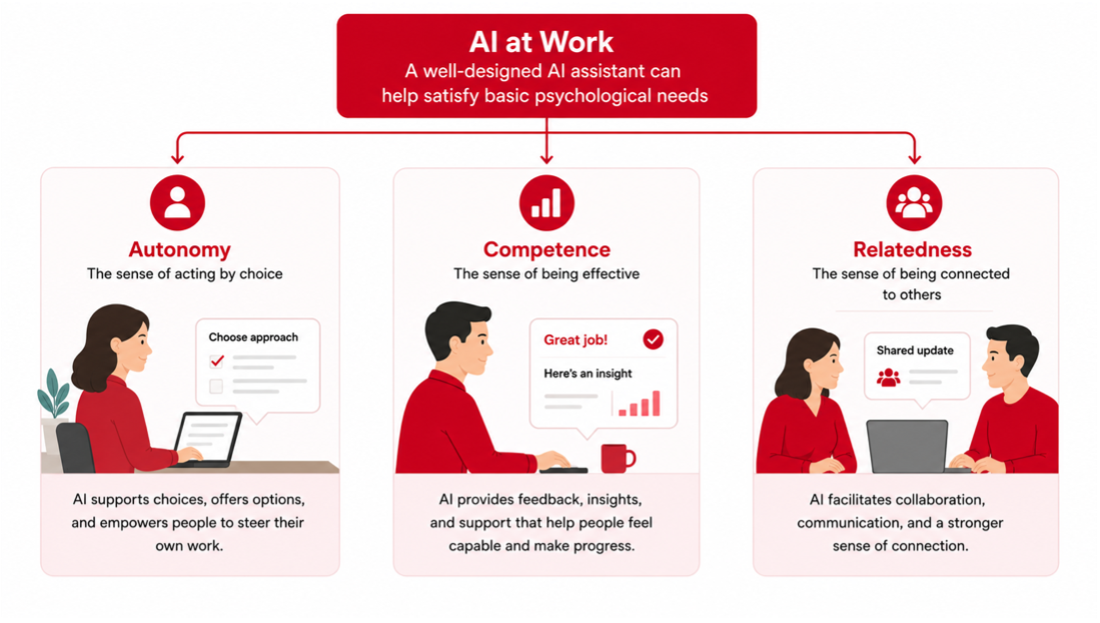
This figure was generated using OpenAI's ChatGPT (GPT-5.5) image generation based on a prompt created by the author.
Partial Confirmation From Our Own Data
In a study of 379 employees who regularly use AI at work, we tested this pathway directly (Watermann et al., 2026). The results were, at first glance, reassuring: trust in AI was strongly associated with all three needs. Employees who trusted the AI tools they used reported feeling more autonomous, more competent, and more connected to the technology while using it. So far, the theory holds, and the Cangrade framing of AI as a potential resource for competence seems plausible.
The Surprising Break
Here is where our findings diverged from that story. None of these AI-related needs were significantly associated with employees' broader workplace well-being or work engagement (Watermann et al., 2026). Feeling capable while using an AI tool, in other words, did not translate into feeling better about work overall.
Read alongside the Cangrade findings, this takes on a sharper edge. Momentary, task-level competence experienced through AI does not appear to accumulate into durable competence, whether measured as broader well-being in our data or as independently assessed critical thinking and problem-solving skills in Cangrade's. Feeling capable with AI's help and being capable without it may be drifting apart.
Why Age Might Be the Missing Variable
Our sample, like the workers described in the Cangrade report, was young and early in its career. This matters because Self-Determination Theory frames need satisfaction as something that accumulates from repeated experience over time, not from isolated episodes (Van den Broeck et al., 2016). If AI use is still a small slice of someone's overall workday, a burst of AI-assisted competence may simply not carry enough weight to shift how someone feels about their job as a whole.
But this raises more of a puzzle than it resolves. Early-career employees are, in principle, still building their professional competence and might be expected to be more responsive to a tool that helps them feel capable, not less. That we did not find the effect even here suggests something structural may be at play, not merely a matter of insufficient experience.
The Mirror Question for Experienced Workers
Which raises the mirror-image question for the other end of the career span. Experienced employees typically arrive at AI-supported tasks with an already well-established professional identity, built over years rather than weeks. For them, an AI tool confirming “you did this well” may add little, precisely because their sense of competence rests on a much larger and more stable foundation. It is even conceivable that the relationship reverses under certain conditions, for instance when AI use is experienced as substituting for, rather than supporting, hard-won expertise (Strich et al., 2021).
Open Research Questions
How competence experienced through AI relates to competence more broadly, across a working life, is only partly understood. From our perspective, several directions suggest themselves.
First, and central for us: the role of age and career stage. Our data cannot speak to this directly, as the samples were young and comparatively homogeneous. A study spanning early-career, mid-career, and older employees would let us test whether the absence of a link we observed is a general pattern or an artifact of a narrow age range. For MIT AgeLab, this question of competence and technology use across the lifespan is a core research interest.
Second, the meaning of competence itself may shift with experience. For a novice, AI-based competence may be about learning a task for the first time; for a veteran, it may be about efficiency or delegation rather than skill-building at all. The same construct may simply mean something different depending on where someone stands in their career.
Third, our data show that organizational support for AI use predicts well-being independent of individual need satisfaction (Watermann et al., 2026). Whether older employees are more, or less, sensitive to that kind of organizational backing than their younger colleagues remains an open question.
Do You Observe This as Well?
If you work with multigenerational teams navigating AI adoption, or study how professional identity and competence develop across the lifespan, we welcome the exchange. This is exactly the kind of boundary condition that only becomes visible once you look across career stages rather than within a single one.
Cangrade. (2026, June 16). The strengths and weaknesses of Gen Z and Millennials at work: 2026 Cangrade research. https://www.cangrade.com/blog/hr-strategy/gen-z-and-millennials-strengths-2026-research/
Moradbakhti, L., Leichtmann, B., & Mara, M. (2024). Development and validation of a basic psychological needs scale for technology use. Psychological Test Adaptation and Development, 5(1), 26–45. https://doi.org/10.1027/2698-1866/a000062
Ryan, R., & Deci, E. L. (2018). Self-determination theory: Basic psychological needs in motivation, development, and wellness. Guilford.
Strich, F., Mayer, A., & Fiedler, M. (2021). What do I do in a world of artificial intelligence? Investigating the impact of substitutive decision-making AI systems on employees' professional role identity. Journal of the Association for Information Systems, 22(2), 304–324. https://doi.org/10.17705/1jais.00663
Van den Broeck, A., Ferris, D. L., Chang, C., & Rosen, C. C. (2016). A review of self-determination theory's basic psychological needs at work. Journal of Management, 42(5), 1195–1229. https://doi.org/10.1177/0149206316632058
Watermann, L., Lermer, E., & Kubowitsch, S. (2026). From AI use to positive functioning: The roles of trust and need satisfaction. Gr Interakt Org. https://doi.org/10.1007/s11612-026-00886-9
- Share