AgeLab Welcomes Researchers from THA, LMU, UHH for Poster Session
by Niels Wu
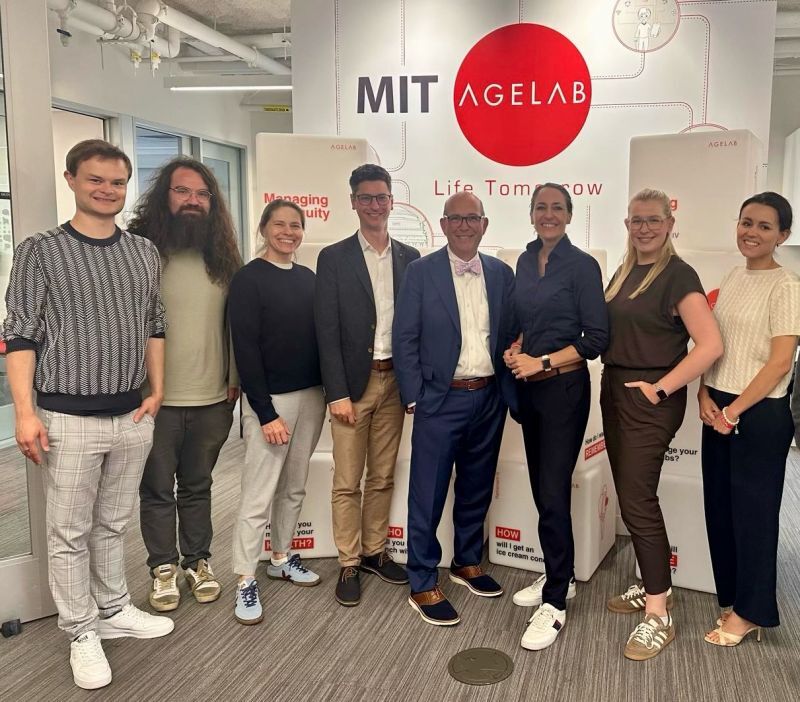
In July, the AgeLab invited a group of visiting researchers from the Technical University of Applied Sciences Augsburg (THA), the Ludwig Maximilian University of Munich (LMU), the University of Hamburg (UHH), and the University of Regensburg (UR) to share their research and brainstorm institutional collaborations. The visitors were Dr. Eva Lermer of THA/LMU, Dr. Stephan Zimmermann of THA, Dr. Simone Kubowitsch of THA, Dr. Silvan Mertes of THA, Lara Watermann of THA, Marvin Grabowski of UHH, and Fiona Kubowitsch of UR.
The researchers organized an informal poster session to demonstrate their projects to AgeLab and CTL staff.
Lermer’s poster, “Navigating the complexity of AI adoption in psychotherapy by identifying key facilitators and barriers,” described a study in which therapists and patients were asked about what factors encourage or hinder AI use in psychotherapy. In general, AI was welcomed as a complement to therapy rather than as a replacement, underscoring the importance of human contact to effective therapy.
Fiona Kubowitsch’s poster, “Communicating Effectively with AI in Healthcare: How Construal Level and Message Framing Shape the Persuasiveness of AI-Generated Medical Advice,” which also featured Lermer as a collaborator, contained results from an online experiment investigating how AI-generated medical advice can be communicated more persuasively. Participants were found to be more persuaded by AI recommendations with tailored messaging than those they felt personally closer to.
Mertes’s poster, “VoiceX as a Design Tool for Virtual Agents' Voices,” provided an overview of VoiceX, a tool that creates customizable voices for text-to-speech systems. Although generated text today can be highly realistic, creating voices that fully mimic human speech remains a complex challenge.
Watermann’s poster was titled “DaTeamVR: Data-driven Team Insights in Virtual Reality” and featured Simone Kubowitsch as a collaborator. It described the process for creating an automated machine learning tool that uses speech, physiological, and movement data from VR team tasks to produce an objective measure of team functioning.
Grabowski’s poster, “Reconfiguring Virtual Collaboration: Developing a Taxonomy for Effective VR Meetings,” summarized qualitative interviews with workers who had experience participating in VR meetings. It aimed to inform a taxonomy that identifies whether VR meetings offer additional value over more familiar virtual meeting formats such as conference calls.
Lastly, AgeLab visiting PhD student Vanessa Yarza Navarro-Schär also presented at the session. Her poster, which she produced in collaboration with Watermann, was titled " From Trust Violation to Calibration: Effects of Different Trust Repair Strategies in Human-AI Medical Advisory” and discussed an online experiment on how AI chatbots should respond after giving incorrect medical advice. Overall, explanation-based strategies were found to be more effective than an apology alone. Yarza Navarro-Schär's findings relate to her ongoing research at the AgeLab focused on humans’ trust in AI.
Thank you for the visit, all!
Vanessa Yarza Navarro-Schär
- Share